Does Interracial Marriage Generally Go Against God’s Normative Design?
A Theological and Personal Response
I couldn’t believe what I was seeing. A legitimate debate about whether or not interracial marriage is “ideal” or what God has in mind as “normative.” There is a lot that is going on with this discussion. And the fact that this debate is even happening is wild and deeply saddening to me. Honestly, there could be an entire PhD dissertation that could (probably should) be written about how being so committed to a theological and philosophical ideology stripped from Biblical exegesis is problematic at best and utterly devastating at worst.
I actually wrote a section in a PhD paper some years ago identifying how God views “multi-ethnicity” and what his “ideal” is for humanity. Check it out, and let the Biblical text drive your theology, not political ideology or philosophy.
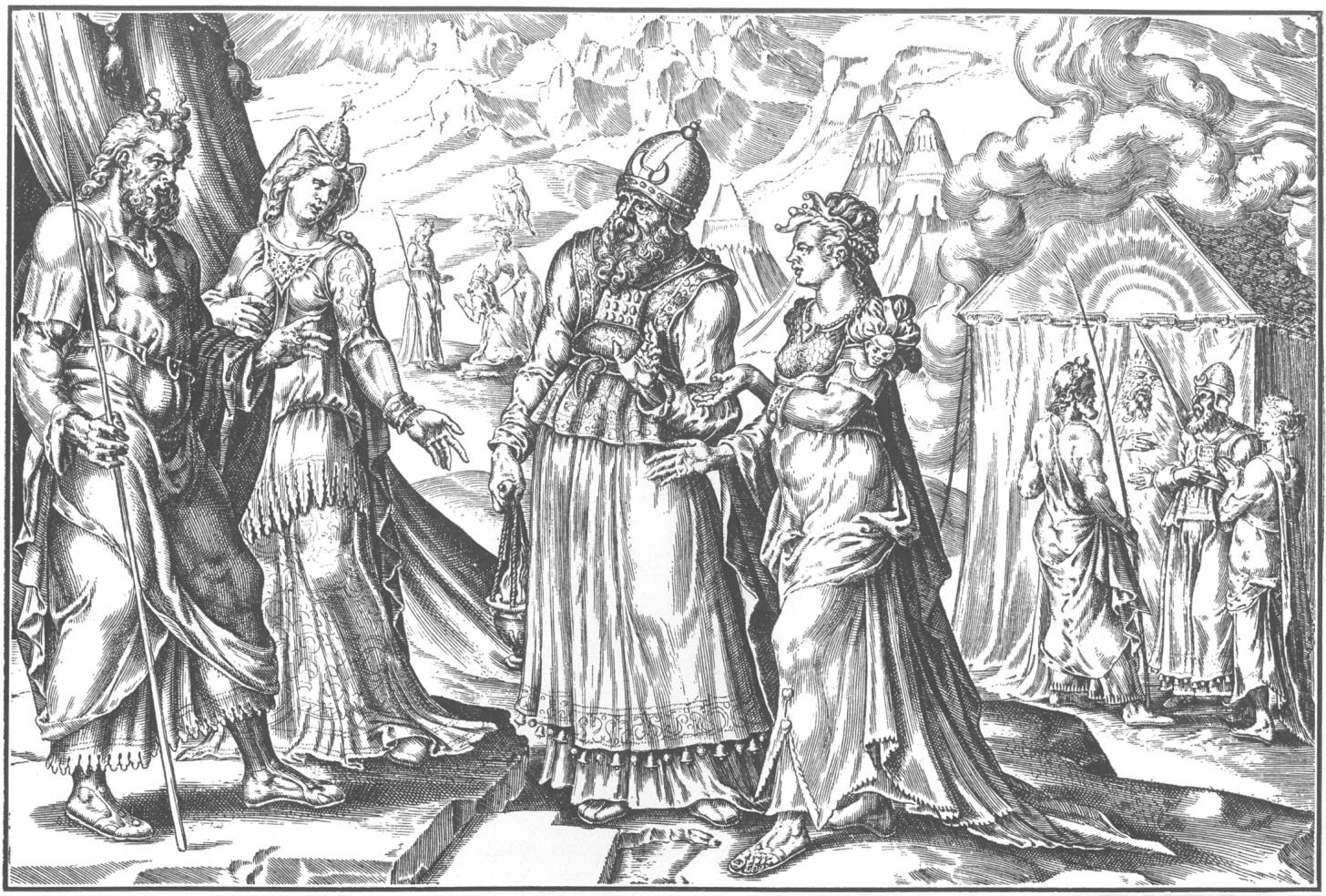
(Source: Horne, Charles, and Julius Bewer. The Bible and Its Story: The Law, Leviticus to Deuteronomy. Vol. 2. New York, NY: Francis R. Niglutsch, 1910.)
A Lesson on Interracial Marriage From Moses:
The nature of Moses birth and early childhood in a sense makes Moses both an Israelite and Egyptian. Moses is born a Hebrew but adopted and raised by Pharaoh’s daughter as a real Egyptian prince. Further, a clue that shows us how much this Egyptian influence has impacted Moses is in the Midianite priest’s daughters referring to, “an Egyptian” who saved them from the hands of shepherds (Exod 2:19).[1] Rondel Hendel makes an important observation regarding the “unique” nature of Moses. He says:
Moses is the unique man, the likes of whom “never again arose in Israel,” in large part because he combines the traits of so many opposed and even incompatible categories. Because he is the multifaceted man, he is able to unite together all of the stories of Exodus, Sinai, and wanderings into a coherent collective memory.[2]
In order to bring further clarity to Hendel’s observation of what makes Moses “unique” is the personal understanding of ethnicity and cultural implications that surrounded Moses. He was in all technical terms “royalty” but a royalty of another ethnicity and people group. Therefore, what Moses does in deliverance is take his people, the Israelites; from the subjugation of one king (Pharaoh) to the authority of the divine king, Yahweh.[3] In this process, Moses serves a Yahweh’s vice-regent joining the ranks of Adam, and Abraham as a type of king.
However, the impact of ethnicity does not stop at the birth and background of Moses but steps intimately into his own life concerning marriage. It is in this space that we find some interesting aspects of how God views ethnicity concerning His people. In Exodus 2:11-22 we find Moses fleeing to Midian and rescuing the daughters of a Midianite priest, Reuel (Ex 2:17). Moses finds both a home, wife and family in Midian (Ex 2:21-22) all of which deserve further exploration.
Daniel Hay’s gives us a helpful reminder concerning the narrative elements of Scripture. It is not merely the law that teaches us theology.
Hay’s says, “So the marriages of Moses—or perhaps we should say the intermarriages of Moses—have something to say to us theologically.[4]
We will find that the intermarriages of Moses will teach us theologically that God intended for inclusion of a multitude of ethnicities amongst His covenant family and within the Kingdom of God. The interaction between Moses who is an Israelite by birth and an Egyptian by adoption and the Midianites is an in interesting symbolic imagery of the situation Moses finds himself in. One foot in Egypt, another foot in Israel; yet now finding a home and wife with the Midianites. The Midianites were ethnic cousins of the Israelites.[5] As a historical society present in the Joseph narrative (Gen 37:25-26) they are traders that travel by caravans. The name “Midianite” interchanges with “Ishmaelite” possibly to explain the eventual deceasing of the Midianites as a unique people but later identified as an ethnic group later called Ishmaelites.[6]
Midian becomes an essential location for Moses because it is here that he finds a home, wife, and family. Egypt had never indeed been home for Moses, and his kinsmen had even rejected him.
It is interesting that the places Moses was most familiar with he found himself as a stranger, yet the land and people he had no familiarity with he found a family.[7]
Theologically, it is also important to note that Moses does not go after the gods of the Midianites or his wife. Instead, he calls the Midianites to follow the one true God. The invitation takes place in Numbers 10:29 but the Midianites decline the offer.[8] However, this is the call of a type of King to include ethnic outsiders to become ethnic insiders within the kingdom. This is the invitation that King Jesus makes to humanity.
Moses has a second recorded intermarriage in Numbers 12:1, “Miriam and Aaron spoke against Moses because of the Cushite woman whom he had married, for he had married a Cushite woman.” A Cushite would have been a resident of the African region of Kush which relates to modern Ethiopia (Num 12:1; 2 Sam 18:21–32; Isa 20:4; Dan 11:43; Amos 9:7; Zeph 2:12).[9] It would not have been uncommon for Moses to have interaction with Cushites as he was raised in Egypt where many Cushite’s would have lived and worked. Further, there are non-biblical accounts that record interaction with Moses and Cush. Josephus records a story where Moses leads the Egyptian and Hebrew armies against the Cushite’s to deliver Egypt from invasion.[10]
Therefore, the presence of the Cushite’s is not uncommon, and Moses marries a black African, and his brother and sister speak against him. It is interesting to note the response of God in light of these events.
First, God does not rebuke Moses for an inter-ethnic marriage. The rebuke that does take place is towards Aaron and Miriam for their actions against Moses.
Second, the punishment that Miriam receives is in a sense an irony. Miriam becomes leprous and white “like snow” the complete opposite of the skin color of the wife of Moses. Therefore, it seems the punishment that Miriam receives is an intentional response against her prejudice against a black wife.[11]
Third, the theological implication of such prejudice is seen through the consequences given to Miriam. Miriam is set outside the camp and sent away from the family and kingdom of God while the Cushite woman becomes part of the family of Moses and the Israelite people through marriage.[12]
The impact of this type of intermarriage is seen in the language used in Numbers 12:38 that speaks to the “mixed multitude” that came out of Egypt. These people could have been a result of intermarriage and even related Semitic groups that found an opportunity to gain freedom through the victory of God.[13]
Therefore, the mixed multitude in a sense was ingrafted into the “kingdom” of Israel theologically rather than purely biologically.[14] All of this points to the intention of God to have a multi-ethnic people within His kingdom family.
Conclusion:
I’ll write more about this concept but I think it is very important to note that embedded into the very fabric of the Israelite community is presence of Multi-ethnicity. We can ignore this or avoid it. The very 12 tribes themselves are made up of Manasseh and Ephraim the half Israelite and half Egyptian children of Joseph!
All of this is Spiritual Warfare. Learn more about how to identify the tactics of the enemy and stand firm in the victory of the Cosmic King of Heaven and Earth, Jesus. All of this and more in my book, “The Unseen Battle.” Available now for “Pre-Order.” Your pre order really helps as it indicates to the Amazon how many copies to have so there aren’t any issues on release day! Appreciate your support!
[1] Ronald Hendel, “The Exodus in Biblical Memory:,” Journal of Biblical Literature 120 (2001): 617.
[2] Ibid, 616.
[3] Ibid, 618.
[4] J. Daniel Hays, From Every People and Nation: A Biblical Theology of Race, ed. D. A. Carson, vol. 14, New Studies in Biblical Theology (Downers Grove, IL; England: InterVarsity Press; Apollos, 2003), 70.
[5] Ibid, 70.
[6] George E. Mendenhall, “Midian (Person),” ed. David Noel Freedman, The Anchor Yale Bible Dictionary (New York: Doubleday, 1992), 815.
[7] John I. Durham, Exodus, vol. 3, Word Biblical Commentary (Dallas: Word, Incorporated, 1998), 24.
[8] George E. Mendenhall, “Midian (Person),” ed. David Noel Freedman, The Anchor Yale Bible Dictionary (New York: Doubleday, 1992), 816.
[9] Major Contributors and Editors, “Cushites,” ed. John D. Barry et al., The Lexham Bible Dictionary (Bellingham, WA: Lexham Press, 2016).
[10] Flavius Josephus and William Whiston, The Works of Josephus: Complete and Unabridged (Peabody: Hendrickson, 1987), 265.
[11] J. Daniel Hays, From Every People and Nation: A Biblical Theology of Race, ed. D. A. Carson, vol. 14, New Studies in Biblical Theology (Downers Grove, IL; England: InterVarsity Press; Apollos, 2003), 75–76.
[12] Ibid, 76.
[13] R. Alan Cole, Exodus: An Introduction and Commentary, vol. 2, Tyndale Old Testament Commentaries (Downers Grove, IL: InterVarsity Press, 1973), 120.
[14] John I. Durham, Exodus, vol. 3, Word Biblical Commentary (Dallas: Word, Incorporated, 1998), 172.


