
He Is Risen
And That Changes Everything

Easter is a strange day if you think about it long enough.
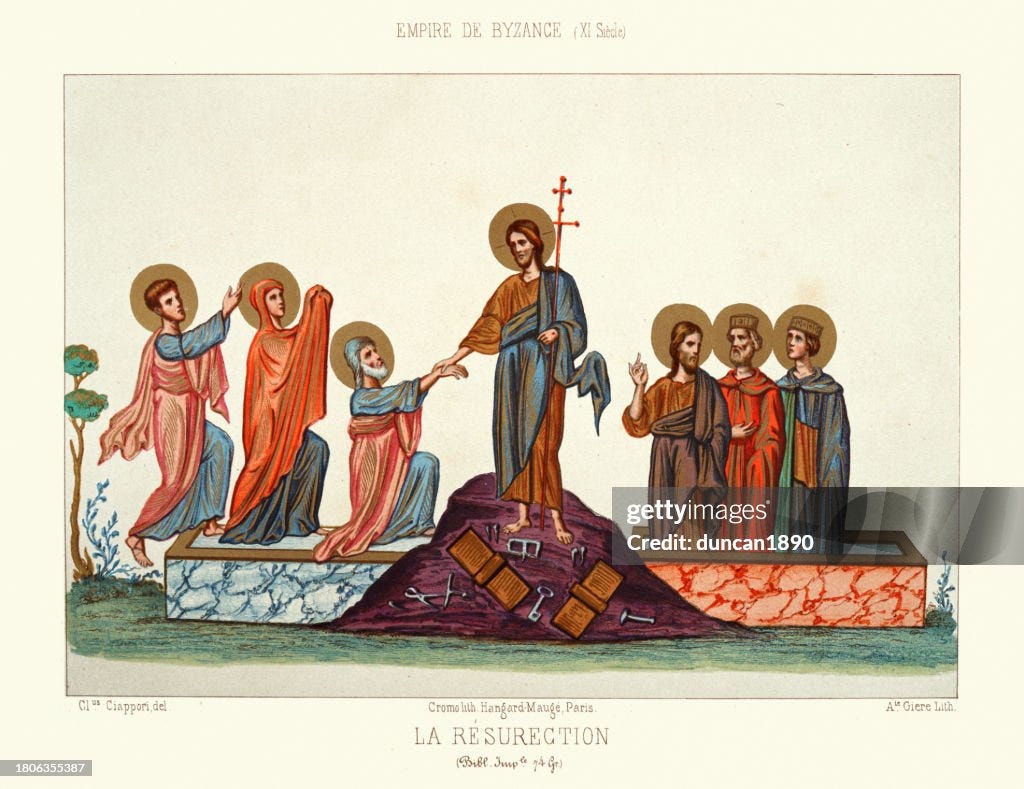
We gather, we sing, we say the words — *He is risen, He is risen indeed* — and then we go home and eat ham (or Chicken Biryani) and wonder if we actually believe what we just said. Not because we’re bad people. But because the resurrection is an audacious claim. A man died. A man rose. And somehow, that changes everything about everything.
I was once asked on a podcast if there was anything that could shake my faith and cause me to move from belief to disbelief.
I responded simply - Yes, show me the body.
So let’s slow down and actually deal with it.
The Cross Was Not a Defeat
Before we get to the empty tomb, we have to understand the cross rightly. Because most people, even many Christians; read the cross as a tragedy that God turned into a triumph. Like Jesus lost round one and won round two.
But that’s not what happened.
Jesus on the cross was victorious, not defeated. Here’s why that matters: the cross was understood in the ancient world as the ultimate sign of judgment and shame. It was the place where criminals were condemned. It was Rome’s loudest statement that this person had been tried, found guilty, and executed.
But Jesus reverses this. He doesn’t just survive the cross — He judges sin and death on the cross. The place of judgment becomes the instrument of victory. The victory of Jesus makes possible our reconciliation, repairing the rupture that impacted all of creation at the fall — the relationship between God and humanity, fractured in Genesis 3. And that reconciliation isn’t just individualistic, its communal. It sends us outward. The reality of our union with Jesus requires us to proclaim His victory in a broken world that is desperately longing for restoration.
Which is exactly what Easter is.
Dealing With Our Doubt
John 20:1-10 gives us a scene of confusion and doubt. The women come to the tomb. The disciples run. Nobody quite knows what to make of the empty grave. And Luke 24 tells us that when the women reported what they had seen, “these words seemed like nonsense to them.”
Could the resurrection actually be true?
It’s a fair question. Let me give you two reasons to take it seriously.
First: It was anticipated. Psalm 16:10 declares, “You will not abandon me to Sheol; you will not allow your faithful one to see decay.” Scholars have traced the messianic prophecies of the Old Testament and found close to 300 — all of them fulfilled in Jesus. Just take 8 of those 300. The mathematical probability of one person fulfilling just 8 messianic prophecies by chance is 1 in 10 to the 17th power. That’s a 1 with 17 zeroes behind it. To illustrate: it would be like filling the entire state of Texas with silver dollars one foot deep, marking one of them red, mixing them all together, blindfolding someone, and asking them to reach down and pick the marked coin on the first try.
Second: There is no body. 2,000 years later and nobody has produced a skeleton. No bones. No grave. Every alternative theory
The swoon theory
The stolen body theory
The hallucination theory,
The twins theory
All of these collapses under scrutiny. What we do have is endless evidence of a man who fulfilled every messianic prophecy of the Old Testament, who lived and loved his people to the point of death, and whom death and sin could not hold in the grave.
The empty tomb is empty because Jesus is victorious.
What the Resurrection Means
Paul puts it plainly in 1 Corinthians 15: “Death has been swallowed up in victory. Where, death, is your victory? Where, death, is your sting?” So what does the resurrection actually mean for us?
The resurrection puts the dark forces of the world on notice. It dealt a fatal blow to the enemy. Their final defeat is not coming — it has already been secured. As Paul writes, “None of the rulers of this age knew this wisdom, because if they had known it, they would not have crucified the Lord of glory” (1 Cor. 2:8). The cross looked like their victory. It was their undoing.
The resurrection is a promise of new heavens and new earth. In his resurrected body, Jesus walked, talked, ate, and was in fellowship with those he loved. This is a preview. Revelation 21 tells us that God’s dwelling will be with humanity, that death will be no more, grief will be no more, crying and pain will be no more. The resurrection of Jesus is not just about what happened to Him. It’s a down payment on what happens to all of creation.
This Is Why We Say, “He Is Risen”
So when we say “He is Risen” on Easter Sunday, we are not just reciting a tradition.
We are proclaiming a statement of fact, backed by eyewitnesses and a 2,000-year tradition that has never been successfully refuted.
We are testifying to something that this broken world longs for — that death is not the end, that sin does not win, that the story is not over.
And we are declaring a truth that is available to us as well. Because He rose, we can rise. Because He lives, we can have eternal life. Because He is united to the Father, we can be united to the Father.
He is risen.
He is risen indeed.
And that is the most important thing you will hear today. And these words will continue to be proclaimed until the one who is risen, returns.