

Does the fact that the Scriptures refer to Jesus as a “son” also mean that he is a “creature”? A being that came into creation and is therefore ontologically (in essence) inferior to the one that brought it into existence, in this case, God the Father?
This was a question the first-century church cared deeply about. It is also a question that has come up again in theological and scholarly circles in recent years, often under the name “the eternal subordination of the Son”, the idea that Jesus is eternally subordinate to the Father in all things.
There is some nuance here that distinguishes it from the first question. Many scholars who hold to the eternal subordination of the Son would also wholeheartedly agree with the pre-existence of Christ. For them, Jesus is not a created being, which is an important distinction to make in modern conversations.
At the core of the question, however, is still the nature of the relationship between the humanity and divinity of Christ, and thus the relationship between the Father and the Son.
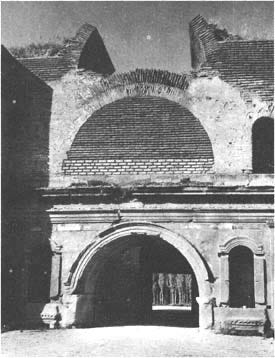
(Byzantine triumphal arch at Nicea (modern Iznik, Turkey). The first Council of Nicea (a.d. 325) debated the Arian controversy, resolving that Christ was “begotten, not made,” “of one essence with the Father.” (B. K. Condit).)1
Considering the Historicity of This Conversation
The early church, specifically in the pre-Nicene period, did not have a consensus statement in regard to this question. That is what led to the fourth-century rise of the “Arian controversy.”
The theology of the Arians can be summarized as:
God was not always the “Father” — there was a time when God was simply “God” and not “Father.”
The Son (Jesus) is a creature, created out of nothing by God.
There are several “powers” of God that were present prior to the creation of the Son.
The stability and sustenance of the Son is predicated on the Father.
We could summarize the main issue this way:
Central to Arian teaching is the insistence that the Son is alien from the divine being and distinct from God — even though he can be called “divine,” he is not true God.2
Arians would have been happy to say that Jesus is the Son of God and that he was “begotten” of the Father. But the nature of “begotten” for them was synonymous with “creating,” which led them to believe that Jesus was both subordinate and inferior to the Father.
This is what we would call today — heresy.
Nicaea’s Answer: The Son Is of the Same Substance
This led early church fathers such as Athanasius, Gregory of Nyssa, Basil of Caesarea, and others to agree upon the homoousion (same substance) of the Son with the Father. This means that the Son is pre-existent and eternal. In other words, there was never a time when the Son of God did not exist. There is no diminishment in the divinity of Christ. This concept found its way into the language of the Council of Nicaea (325).
Athanasius puts it this way:
But since the generation of the Son from the Father is not according to the nature of men, and not only like, but also inseparable from the essence of the Father, and He and the Father are one, as He has said Himself, and the Word is ever in the Father and the Father in the Word, as the radiance stands towards the light (for this the phrase itself indicates) ... 3
The Westminster Confession of Faith says it this way:
In the unity of the Godhead there be three persons, of one substance, power, and eternity: God the Father, God the Son, and God the Holy Ghost (1 John 5:7; Matt. 3:16–17; Matt. 28:19; 2 Cor. 13:14). The Father is of none, neither begotten, nor proceeding; the Son is eternally begotten of the Father (John 1:14, 18); the Holy Ghost [eternally proceeding] from the Father and the Son (John 15:26; Gal. 4:6). 4
The Incarnation Is Not the Son’s Beginning
When we think of the incarnation, we should not think of it as a “beginning of creation for the Son.” Instead, as John Webster notes,
The incarnation is therefore not a further instance of a process of becoming, of which the divine life and activity are also part. Nor is the incarnation a creaturely movement; it is free, gratuitous and ex nihilo, the exercise of the divine good pleasure and not a necessary consequence of any state of affairs beyond the loving will and purpose of the Father who sends and the free, active obedience of the Son or Word. 5
Jesus Is the Begotten Son of God, but Not Created
A lot of ink has been spilled on this topic. In John 1:14 we find the Greek word μονογενής/monogenes, which is a compound word. The first part, μονο/mono, carries the sense of “only” or “one.” The second part, γενής/genes, is talking about kind or class, something that is unique or distinct. Put together, the word deals with the nature of that uniqueness.
To summarize, this word refers to the unique, unparalleled, and incomparable nature of Jesus as the “only Son.” So this may be surprising, but the Greek word has less to do with “begetting” and more to do with being unique, unparalleled, and distinct in nature and class.
There are theological reasons for the translation “begotten,” and they can be traced to Jerome and how he translated this word in various places in the Latin Vulgate. Jerome was dealing with a theological issue with the Arians, who claimed Jesus was made, not begotten. So when monogenēs was connected to Jesus, Jerome used the translation “only begotten.” That influenced the KJV, which in turn influenced other modern translations.
So, to simplify it: the Greek word monogenēs means “one of a kind.”
This translation is reinforced by the Hebrew yāhîd, which can be translated as “only, precious” (Gen. 22:2, 12, 16).
Tertullian saw the same thing centuries earlier:
Then, therefore, does the Word also Himself assume His own form and glorious garb, His own sound and vocal utterance, when God says, “Let there be light.” This is the perfect nativity of the Word, when He proceeds forth from God — formed by Him first to devise and think out all things under the name of Wisdom — “The Lord created or formed me as the beginning of His ways;” then afterward begotten, to carry all into effect — “When He prepared the heaven, I was present with Him.” Thus does He make Him equal to Him: for by proceeding from Himself He became His first-begotten Son, because begotten before all things; and His only-begotten also, because alone begotten of God, in a way peculiar to Himself, from the womb of His own heart — even as the Father Himself testifies: “My heart,” says He, “hath emitted my most excellent Word.” 6
Jesus is the “one of a kind/unique” Son of God, who is fully God Himself. He is the invisible God made visible and is not in any way inferior in quality or essence (ontology) to the Father. In the Incarnation, Jesus willingly submitted Himself to the Father so the mission and plan of the Godhead (God the Father, God the Son, and God the Spirit) could be fulfilled in human time and space, ultimately leading to the cross and through the grave into the resurrection.
Continue Reading:
The Spirit of the Age: Contempt

I know of a few things that can really get someone going. I mean, get their blood pressure up. Some of these will sound trivial to you but just follow me for a second. When someone says that iPhones are by far the superior devoice and androids will only bring risk of explosion in your hand.
G. W. Bromiley, D. Orthodoxy, and D. M. Baillie, “Christology,” in The International Standard Bible Encyclopedia, Revised, ed. Geoffrey W. Bromiley (Wm. B. Eerdmans, 1979–1988), 663.
T. McCall, “Sonship,” in New Dictionary of Theology: Historical and Systematic, ed. Martin Davie et al. (London; Downers Grove, IL: Inter-Varsity Press; InterVarsity Press, 2016), 855.
Athanasius of Alexandria, “De Decretis or Defence of the Nicene Definition,” in St. Athanasius: Select Works and Letters, ed. Philip Schaff and Henry Wace, trans. John Henry Newman and Archibald T. Robertson, vol. 4, A Select Library of the Nicene and Post-Nicene Fathers of the Christian Church, Second Series (New York: Christian Literature Company, 1892), 164.
The Westminster Confession of Faith (Oak Harbor, WA: Logos Research Systems, Inc., 1996).
John Webster, Word and Church: Essays in Christian Dogmatics, The Cornerstones Series (London; New York; New Delhi; Sydney: Bloomsbury T&T Clark, 2016), 135.
Tertullian, “Against Praxeas,” in Latin Christianity: Its Founder, Tertullian, ed. Alexander Roberts, James Donaldson, and A. Cleveland Coxe, trans. Peter Holmes, vol. 3, The Ante-Nicene Fathers (Buffalo, NY: Christian Literature Company, 1885), 601.