Palm Sunday: An Invitation to Reflect on our Motives
It was the same crowd….
A few years ago, my greatest fear was that people would not know the name of Jesus. Today, that is no longer my greatest fear.
My greatest fear is: what Jesus will they be presented?
In a world consumed with “what can I get” and “how does this benefit me” — in a culture that designs mobile devices to make taking selfies easier and almost automatic, we find ourselves in great danger.
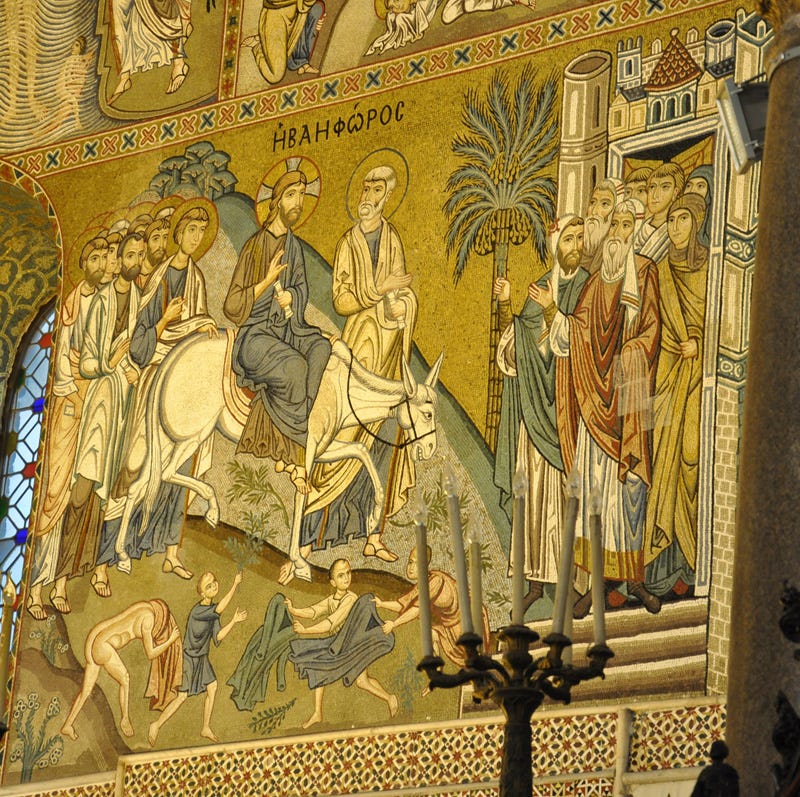
(Source1)
And before we think this is a new or novel idea, we would be wise to remember that there is nothing new under the sun. The people who celebrated Jesus as he entered Jerusalem had their own motives and agendas. They had their own terms, their own conditions, for accepting the kingship of Jesus. Those terms were communicated through the symbols they held and the words they shouted.
John 12:12–15 (CSB): The next day, when the large crowd that had come to the festival heard that Jesus was coming to Jerusalem, they took palm branches and went out to meet him.
It would be easy to gloss over the symbol of palm branches, but that would be a crucial mistake. The palm branch was both a religious symbol and a symbol of revolt and rebellion. In 1 Maccabees 13:51, there is a historical description of a celebration for Simon of the Maccabees after a victory over the Syrians. Earlier in Jewish history, the palm was even minted on coins during times of rebellion. In other words, by the time Jesus is being celebrated, the palms had become a symbol of nationalistic hope — and the people greeted Jesus with nationalistic expectation.
The symbols they held powerfully reinforced the words they shouted.
The word Hosanna is Aramaic, literally a plea: “Save us, please.” The next phrase — “Blessed is the one who comes in the name of the Lord” — comes from Psalm 118:26, likely a greeting used for a king leading his people into the temple after a military victory. The strings attached to their cheers were rooted in nationalistic hope and the expectation of an earthly king. In all fairness, this is completely understandable. But it was not the intent or aim of Jesus.
Have you ever considered the symbols and words of Jesus in response?
Jesus rides in on a donkey. This was intentional and should have been an alarming sight for the cheering crowd. In the ancient world, the symbol of war was a horse, a stallion. The symbol of peace was a colt, a donkey. Jesus rode in on the symbol of shalom - not war. He kept teaching his disciples, then and now, that the ethics of the Kingdom of God are subversive to the kingdoms of the world. Just read Matthew 5 the Sermon on the Mount, specifically the Beatitudes.
In just a few days, the same crowd that cheered Jesus with celebration would chant and scream for his crucifixion.
The. Same. Crowd.
Let that sink in.
How do we know it’s the same crowd?
Both John 12:12 and Matthew 21:15 use the Greek word ὄχλος to describe the crowd Luke calls disciples. The word ὄχλος/crowd means a massive mob, a gang, an assembly of people. It is the exact same word used for those who gathered in Matthew 21:15. The ὄχλος yelled to release Barabbas and crucify Jesus.
As we ponder this change of heart by the same crowd that once cheered for their arriving King, only to cry out for his death days later - we have an opportunity to reflect in a way that crowd did not.
Today, Palm Sunday, is where we are confronted with our terms. Our own preconceived notions of who we want Jesus to be and how we want him to act. We see it in the world today.
The world wants war, believing that peace can only be achieved through force. Jesus brings peace through his own suffering and self-sacrifice on the cross.
The world wants unity through uniformity found in echo chambers of worldviews that treat Godly virtues like humility, compassion, and empathy as weaknesses to be rejected at all costs. Jesus establishes a unity marked by diversity. There is room in the family of God for you to be distinctly who you are as long as, as the Apostle Paul says in Romans 12, we all live in harmony.
To live in harmony is to have our thoughts, actions, and beliefs ordered by our allegiance to King Jesus.
The world wants to exalt the strong, the proud, and the powerful. Jesus shows us that God uses the weak, the powerless, and the humble for his purposes.
So what is the actual condition of our hearts in relationship to Jesus? Do we want Jesus on our terms, or his?
We are so consumed with me that the person of Jesus has been repackaged in our own image to meet our own needs and desires. This is, in fact, a perversion of sanctification. Sanctification has both an aim and an ambition. The aim is King Jesus. The ambition is to become like the one we are aiming for.
Everything in me wants to tie this up in a neat bow. But sometimes, that’s the worst thing we can do. The best thing is to sit in the tension — to allow the uneasy conflict within our souls to lead us to honesty, humility, and ultimately a willing submission to Jesus on his terms.
A key to living in submission and allegiance to Jesus is the ancient virtue of humility. Humility is the soil of the Christian life. We are planted into the humble life of Christ. We grow from that place in spiritual maturity as we are being conformed into the image of Jesus. These next few days leading up to Easter would be the perfect time to dedicate to cultivating humility. You can do this intentionally by reading, “The Hidden Peace.” A book that unpacks the Biblical theology of humility and why it is so important for our lives today.
https://www.christianiconography.info/sicily/palmSundayPalatineChapel.html


