Raw Thoughts on Gratitude and Grief
Discerning the moment
“The church can’t survive on sentiment and nostalgia. Sentiment, nostalgia, optimism - these are weak thin fuels.” - Fleming Rutledge"
It’s early in the morning. I usually write my posts weeks in advance. So I have time to edit them. If they’re deeper theological posts, I try to get other people’s eyes on them for feedback. But this morning, Thanksgiving morning, I woke up early to sit down and just write some words from my heart. Not polished. Not neat.
Just raw.
(Source:1)
Giving thanks when things aren’t the way you thought they would be is tough. Most often it’s pretty dysregulating. Normally for Thanksgiving my family and I go to Houston to celebrate with our extended family. It’s quite the scene to behold. We’ve been doing this since I was in high school. My Uncle Calvin moved from Illinois to Houston. The distance created a reason for us to be intentional with holidays. So he made it a staple. We always go to Houston, to his house, for Thanksgiving.
For twenty-five-some years this has been the case. A few years here and there due to travel or sickness we may miss. But our extended family of ten, over the last twenty-five years, has turned into twenty-five-plus. The one constant: Houston for Thanksgiving. Even when things got seriously uncomfortable for us to stay in his house, it didn’t matter. We just stuffed people into closets and corners and made it work.
Love.
This year we had a little mishap in communication. Travel logistics, a pre-planned trip to India, and some other circumstances resulted in half the family in Houston and the other half, my half, in Indiana with my mom.
It’s not exactly what we had envisioned. And honestly, we could have all been depressed and focused on everything we were missing out on.
Last night we went out to a local steakhouse called Nesst, and it was just eight of us. My family, my mom, and my brother. I looked around and realized how grateful I was. My mom is fully recovered and cancer-free after a breast cancer diagnosis. My brother just bought a new house, and we got to see it and hear about what he plans to do with it.
I watched my kids show kindness and compassion to the waitress and the guy who was bussing the tables. Juan, the guy who was waiting on tables, at one point stopped our conversation and looked straight at Levi and the other boys and said to us, “Excuse me, but I thought you all should know your kids are so well behaved, kind, and respectful. Honestly, more so than a lot of adults that come in here.” He was visibly impacted and grateful, and I sat there and took it all in.
It was a discernment moment. Not the kind you think about when we talk about discernment. Often, discernment is used in conversations about really hard decisions, issues of chaos and conflict, trying to make the right choice in the midst of it all. But this discernment moment, a moment that is so everyday, so average, absolutely mundane, is crucial.
I had an option. I could allow my discernment to be framed by all that went wrong. Or I could allow the reality of the moment. The hard and the good, to help me come up with the proper response. Instead of letting my emotions dictate my discernment, they informed it.
What did I discern?
The situation wasn’t ideal. But friend, life is not ideal. More often than not, we face circumstances where we’re left just shaking our heads wondering, “Why?”
Non-ideal situations can’t create absolutes in our view of life. In other words, just because this moment is less than ideal doesn’t mean every moment has to be less than ideal. Can we have eyes to see the beauty of the moment in the midst of things going wrong—and not just when all is right?
Love was still present among the eight, even though we were missing the full twenty-five-plus. Love. Honest love. Not butterflies and good wishes. But genuine love brought us all together.
Theologian Fleming Rutledge says in her book entitled Advent, “The church can’t survive on sentiment and nostalgia. Sentiment, nostalgia, optimism - these are weak thin fuels.”
She is absolutely right. This is why we as believer, rely on love that is embodied in the Hebrew word hessed. This word can be translated simply as “love” but it has inflection points with being steadfast, covenantally faithful, lasting, enduring; it is a love that chases us down in constant pursuit.
This kind of love is a fuel that lasts. It also reminds us of another lasting fuel - gratitude.
Gratefulness is a powerful response to grief. It isn’t a response that rejects grief. It isn’t intended to nullify the pain of absence. But it is a response that lives perfectly in the tension of grief. Gratefulness brings shape to grief in that it highlights the “why” behind our grief. But it also trains our hearts not to be crippled by grief.
Sometimes Thanksgiving can be really complicated. It’s a time to give thanks, but it’s also a time when we feel the tangible presence of loss. We look at the table we used to all gather around, and over the years, we realize that some of those chairs are no longer filled with the people we love. It is tough to process grief while also trying to be grateful. We think that only one emotion can be present. I don’t think this is the case. In fact, I believe this is why the church began to introduce certain elements into the rhythm and life of the church, in order to remind us of the complexity of life and aid us in our discernment process.
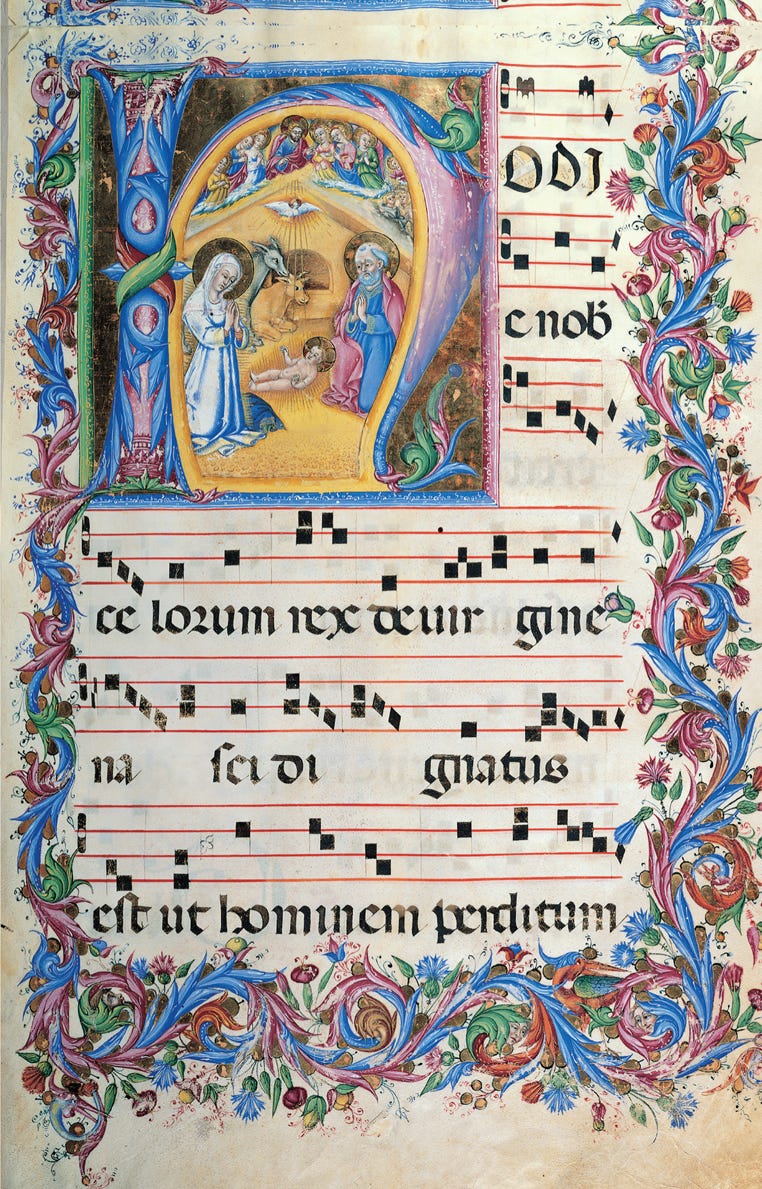
The church in the fourth and fifth centuries came to realize that their wait for the return of Christ was looking like it would be longer than first anticipated.2 So they began to practice a season of waiting called Advent. Advent comes from the Latin word adventus and refers to the “coming of Christ,” but it has a dual meaning. In one sense, it calls us to look back on when Christ first came in the Incarnation—a fulfillment of a promise made to the people of God in the Old Testament. The long-awaited Messiah was born in a manger in Bethlehem.
On the other hand, Advent refers to the promised return of the Messiah, not as the suffering servant who was born in a manger in the Incarnation, but as the conquering King of the Cosmos returning in final victory to retrieve and reclaim the world that rightly belongs to him.
Advent is a season for us as believers to retrieve thanksgiving as a spiritual practice. We give thanks because Christ first came to defeat sin and death on the cross. We give thanks now, even in the midst of the non-ideal, because Christ promised to return again and bring the fullness of his Kingdom to earth—just as he taught us to pray, “on earth as it is in heaven.”
Advent reminds us that we need to stay a discerning people. We need to see the times for what they are. To live in the tension of gratitude and grief. Both can live together.
—
Armstrong, Chris. “Advent: Close Encounters of a Liturgical Kind: ’Tis the Season When Even the Free-Ranging Revivalist Pulls up a Chair to the Table of Historic Liturgy.” Christian History Magazine: The Wonder of the Season, Worcester, PA: Christian History Institute, 2012.
The roots of Advent in the eastern church can be traced to around the end of the fourth century. The celebration of Advent in the Western Church started toward the close of the fifth century, in Gaul, Spain, and Italy. See: Robert Webber, The Services of the Christian Year, vol. 5, The Complete Library of Christian Worship (Nashville, TN: Star Song Pub. Group, 1994), 108. See also: Samuel Macauley Jackson, ed., The New Schaff-Herzog Encyclopedia of Religious Knowledge (New York; London: Funk & Wagnalls, 1908–1914), 55.


Thank you, Joel. Grief gives gratitude another dimension. As children of God we will always have the option to be thankful - even while grieving. It calms our anxious thoughts to pause and reflect - any day of the year - and especially on Thanksgiving - the countless ways He blesses His own. Yes, both grief and gratitude can go hand in hand when our HOPE and ASSURANCE rest in a Person Who never changes. His love and His Presence in us as His people can make a way for gratitude even while we grieve. His blessings outweigh any losses. Praise God for His wonderful Love and Grace that sustains us even in our grief - and continually gives us reason to be thankful.
Happy Thanksgiving, this was such a great message for me to read. Thanksgiving is a both and day for me. Holding grief and gratitude in my hand, and this message was more timely for me to read than I have words for. Have a blessed time with your family today.